
You can now lose your permanent residence permit in Bulgaria within one year.

Permanent residence in Bulgaria is no longer permanent: what the amendments to the Law on Foreigners have changed
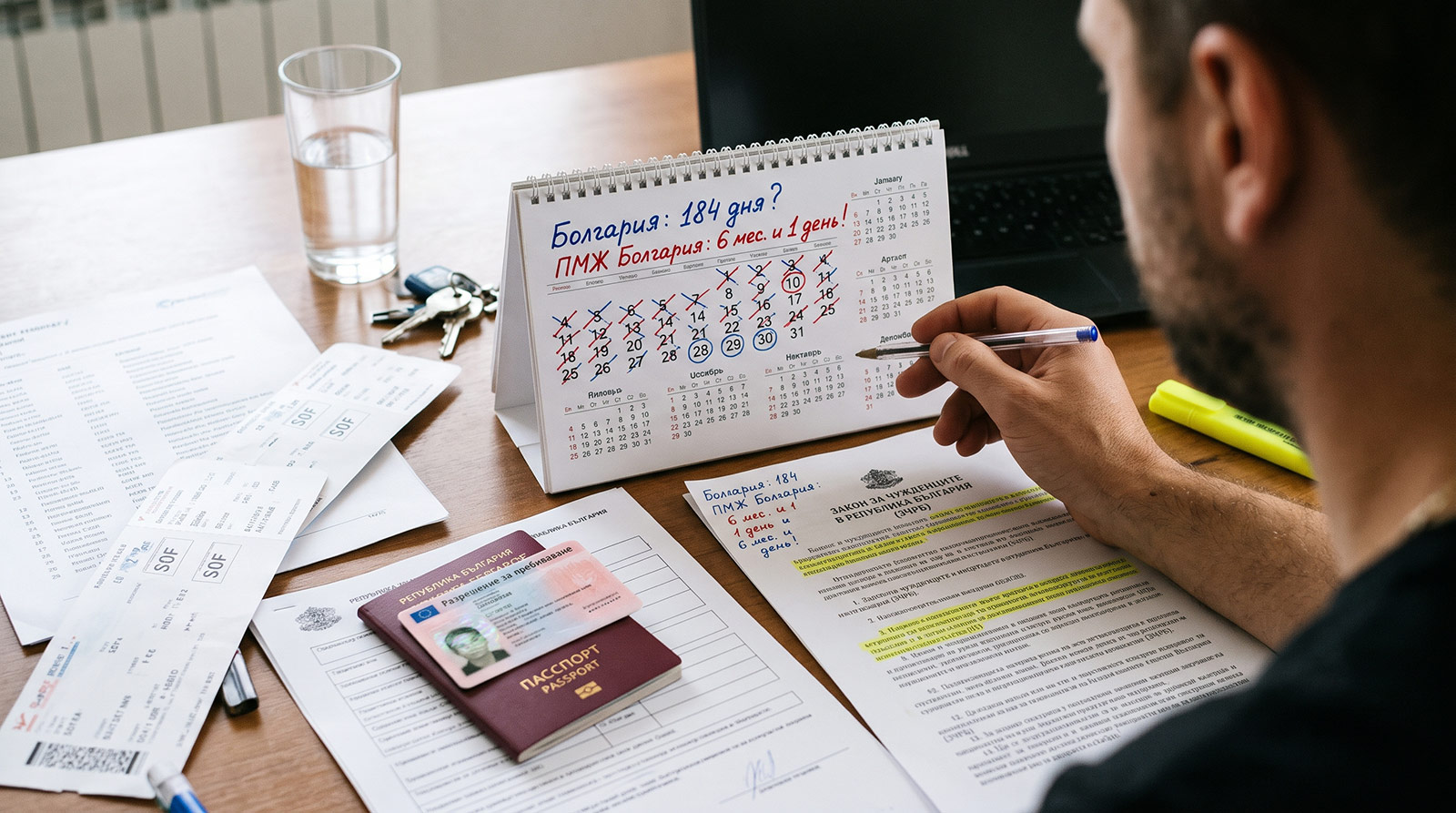
The main thing in 30 seconds: On November 18, 2026, the National Assembly adopted in the second and final reading amendments to the Law on Foreigners in the Republic of Bulgaria (LFRB). For most permanent residence permit holders, the status is no longer "indefinite": if you spent less than 6 months and 1 day, permanent residence is being revoked.
In practice, permanent residency has become similar to a temporary residence permit. The residency requirements are almost the same, but there is no annual renewal or fee. A temporary residence permit is simply not renewed if the permit is violated, while a permanent residence permit are being recalled. This is a coercive measure, after which the status will have to be obtained again.
Below, for each status (temporary residence permit, permanent residence permit, long-term residence permit), we'll break down the status quo, explaining how it was before and how it's now, who is affected by the exceptions, and what to do now. This article is worth saving: you'll need to refer back to it every year when counting your days.
All wording has been verified against the final report of the Parliamentary Committee on Internal Security dated November 17, 2026 (which was voted on in the second reading) and the current text of the Law on the Protection of the Rights of the Child. The transcript of the November 18 meeting has not yet been published on the parliamentary website, and the law has not yet been published in the State Herald. Links are at the end of this article.
In short: what was and what became
The most significant changes were made to the rules for permanent residence. Instead of the requirement of "not being absent from the EU for a consecutive year," you must now reside in Bulgaria for the majority of each year.
| Status | How it was | How it became | Consequence of violation |
|---|---|---|---|
| Residence permit (long term, part 24) | There was no minimum term of stay in the law | You need to live in Bulgaria at least half previous permitted period (new part 26, art. 14) | Refusal to extend |
| permanent residence (constantly prebivane, member 25) | Review after 12 consecutive months outside the EU or 6 years outside Bulgaria | You must be in Bulgaria at least 6 months and 1 day for the previous calendar year (new Art. 40, para. 1, vol. 24). For investors and some family-based reasons, the 12-month rule outside the EU remains in effect (vol. 25). | Review status |
| DVZh (long-term stay in the EU) | Recall after 12 consecutive months outside the EU | Unchanged: Revocation after 12 consecutive months outside the EU (Article 6 in the new version). The "6 months and 1 day" rule for long-term residence does not apply | Status revocation |
| Initial application for a residence permit | Certificate of no criminal record from the country of citizenship/origin or usual residence | Certificates from the country of citizenship/origin и habitual residence (Article 24, Article 2) | Incomplete set of documents |
The articles are listed in accordance with the Law on Foreigners in the Republic of Bulgaria, taking into account the new paragraphs 13 and 17 of the final report.
Residence permit: extension only after residing for at least half the period
How it was. A residence permit (permit for a long stay) is issued under Article 24 of the Law on the Protection of the Rights of the Child, usually for up to one year, and is periodically extended. Article 26 lists the reasons for refusal of extension: failure to meet the conditions, fictitious marriage, forged documents, and stay for another purpose. There was no minimum period of residence in Bulgaria among them. It was possible to have a residence permit and spend only a few weeks a year in the country.
How it became. Section 26 has been supplemented by paragraph 14 (§ 13 of the final report). An extension is denied if the foreigner has resided in the country for less than half of the previous permitted period. Original provision: "Откава се продължаване на ребиваване..." For a one-year residence permit, this is approximately 183 days in Bulgaria.
Important: it is not the calendar year that is counted, but your previous residence permit period, from date to date. An amendment that would exclude absences due to valid reasons (treatment, study, business trip, force majeure) from the calculation, the commission did not support.
Who does the half-term rule NOT apply to? (Residence permit under Part 24, Article 1):
| Point 24, paragraph 1 | Base |
|---|---|
| v. 7 | Parents dependent on a Bulgarian citizen or a foreigner with permanent residence |
| v. 10 | Pensioners with sufficient funds |
| v. 13 | Family members of a foreigner with a temporary residence permit, permanent residence permit, long-term residence permit or protection |
| v. 17 | Victims of human trafficking with special status |
| v. 18 | Family members of a Bulgarian citizen |
| v. 19 | Investors: real estate or private company from €306,775 (previously BGN 600,000) |
| v. 20 | Investors in a company in a lagging region from €127,823 (previously BGN 250,000) |
| v. 21 | Volunteers of the European Voluntary Service |
Who does the rule apply to?. All other grounds for a residence permit. These include, first and foremost, the owner of a company with 10 employees (item 2), a sales representative (item 6), a freelancer (item 15), a correspondent, a patient undergoing treatment, and an employee.
At the same time, all thresholds in Section 24 have been converted to euros. The investment for a trade mission under Section 6 is now €51,129 instead of BGN 100,000. Children under family law (Section 13) retain their residence permit until they graduate from full-time high school, but not beyond the end of their graduation year.


Permanent residence: "Permanent" now depends on each year
How it was. Permanent residency was indeed almost permanent. According to Article 40, Section 1, Vol. 6, it was revoked for absence only in two cases:
- the man spent 12 consecutive months outside the entire EU, and not just Bulgaria;
- the man was absent from Bulgaria 6 years (Article 40, paragraph 4).
All it took was to visit the EU at least once a year, and the status would be maintained. There was no annual renewal or verification of income, housing, or insurance. This is why many received permanent residence and lived in other EU countries or in two homes.
How it became. Section 40, paragraph 1, now includes a new clause, paragraph 24 (§ 17 of the final report). The right of residence is revoked if the permanent residence permit holder spent less than "6 months and one day" in Bulgaria during the previous calendar year. The essence of the changes:
- Counts Bulgaria, not the entire EU. Living in Greece, Spain, or Germany no longer offers salvation.
- Counts sum of days for a calendar year (January 1 – December 31), rather than continuous absence.
- The threshold is strict: more than half a year. Plan for at least 184 days with a reserve.
- The consequence is - status revocation, not a fine or card replacement. This is a mandatory administrative measure. It can be appealed, but you'll have to reapply for the status.
- Exceptions for valid reasons (medical treatment, studies, business trips) and the rule «if presence cannot be clearly established according to the EES data, this will not be interpreted against the foreigner» commission did not accept. They were in the alternative proposal of MP Bogdan Bogdanov.
The only exception is based on the grounds on which the permanent residence permit was issued.
| Grounds for permanent residence (Part 25, Article 1) | The 6 Months and 1 Day Rule« | What acts instead? |
|---|---|---|
| v. 1 — Bulgarian origin | Yes, it works. | — |
| v. 5 — after 5 years of legal residence (for example, pensioners, entrepreneurs and freelancers after a temporary residence permit) | Yes, it works. | — |
| Section 17 - investors after 5 years of residence permit under Section 24, Sections 19 and 20 | Yes, it works. | — |
| vol. 9, 10, 12, 14, 15 (special historical cases, children in institutions) | Yes, it works. | — |
| Part 2 — spouse of a foreigner with permanent residence (5 years of marriage) | No | 12 consecutive months outside the EU → review |
| Item 3 - minor children of a Bulgarian citizen or permanent residence permit holder | No | 12 consecutive months outside the EU → review |
| vol. 4 - parents of a Bulgarian citizen | No | 12 consecutive months outside the EU → review |
| vol. 6, 7, 8, 13, 16 — large investors and certified investment projects | No | 12 consecutive months outside the EU → review |
| Item 11 - Family members of a Bulgarian citizen after 5 years | No | 12 consecutive months outside the EU → review |
| Article 25g - Family members of a Bulgarian citizen under EU law | No | And the 12 month rule doesn't apply either. |
The rule «6 years outside Bulgaria» (Article 40, paragraph 4) is not affected by the amendments and continues to apply to everyone.
Pensioners and Investors: The Trap of Transitioning to Permanent Residence
Pensioner with a temporary residence permit (Part 24, Vol. 10) released from the half-term rule. But after 5 years, he usually moves to permanent residence on a general basis (Part 25, Vol. 5), and there are exemptions not anymore. An investor under Part 24, Section 19 or 20 will face the same consequences when transitioning to permanent residence under Part 25, Section 17.
It turns out to be a paradox: for those who often leave, Remaining on a temporary residence permit may be more reliable than switching to permanent residence. Whether to postpone the transition depends on your travel schedule.
Why is permanent residence now almost an "improved temporary residence permit"?«
| Residence permit after amendments | Permanent residence after amendments | |
|---|---|---|
| Minimum in Bulgaria | Half of the previous term (~183 days per year) | 6 months and 1 day per calendar year |
| When they check | With each renewal | Can be installed at any time ("se ustanovki") |
| Consequence | Refusal to extend | Status revocation |
| Annual renewal and its fee | Yes | No |
| Proof of housing, insurance and funds every year | Yes (Article 24, Paragraph 2) | No |
What advantages does permanent residency still have? You don't need to gather documents every year or pay renewal fees. Permanent residency is still necessary for the subsequent path to citizenship under the general law. However, in terms of the requirement to actually live in the country, the two statuses are now practically equal. Moreover, losing your permanent residency is even more severe than not renewing your temporary residency.
DWJ: the most stable status for those who travel
How it was. Long-term residence permit (permission for long-term resident of the EU) and permanent residence were regulated by the same rule, Part 40, Article 1, Vol. 6. Both statuses were revoked after 12 consecutive months outside the EU.
How it became. T. 6 has been rewritten so that it now concerns only Far East. The rule remains the same: revocation after 12 consecutive months outside the EU. The period of a declared state of emergency is not considered an absence. The "6 months and 1 day in Bulgaria" requirement for long-term residence permit does not apply.
Result: before the amendments, permanent residence and long-term residence with a presence requirement were equal; now long-term residence is noticeably freer.
| Permanent residence (general basis, origin) | DVZh | |
|---|---|---|
| Where you need to be | In Bulgaria | In any EU country |
| Threshold | At least 6 months and 1 day per calendar year | No more than 12 consecutive months outside the EU |
| It is possible to live in another EU country for most of the year | No | Yes |
| You can spend 10 months outside the EU with a trip to the EU | No | Yes |
Conclusion for those living in two countries: if you are already eligible for long-term residence, you should seriously consider this option. Long-term residence requires five years of legal continuous residence and compliance with the time limits for absence during these years. The conditions for transfer are reviewed on a case-by-case basis.
Other changes worth knowing
Two certificates of no criminal record instead of one. In Section 24, Paragraph 2, the words "ili na obichainoto prebyvavane" have been replaced with "i na obichainoto prebyvavane." When applying for a temporary residence permit for the first time, you must provide a certificate from both your country of citizenship (origin) and the country where you usually reside. If, for example, you are a Ukrainian citizen living in Poland, prepare two documents. Allow time for an apostille and translation.
Amounts in euros. The investment thresholds for residence permits are now as follows: €51,129 (item 6), €306,775 (item 19), €127,823 (item 20).
Residence permit for families of education specialists. Section 25a adds education to science and technology. Accompanying family members may also obtain permission.
Labor migration. The procedure for issuing a Unified Residence and Work Permit is limited to two months, with an additional 30 days in complex cases. Unemployment for up to three months is not grounds for revoking the permit. For those who have held it for more than two years, the period is up to six months. If access to the labor market is lost due to the employer's fault, they must pay compensation.
Who will be most affected?
Find your situation in the table. The risk is highest for those with permanent residence by descent or common grounds, and who primarily live outside Bulgaria.
| Situation | Risk | What to do |
|---|---|---|
| Permanent residence by Bulgarian origin, living in another EU country | High | Either spend 184+ days in Bulgaria or accelerate citizenship by descent |
| Permanent residence after 5 years of temporary residence, work remotely and travel a lot | High | Plan your trips using the calendar and evaluate the transition to the Far East |
| A pensioner with a temporary residence permit, spending the winter at home | Low while you have a residence permit | Don't rush into permanent residence if you're not prepared to live in Bulgaria for more than six months. |
| Residence permit through your own company or trade representative office | High | It's no longer a matter of a formal address: you need to live in Bulgaria for at least half the term |
| Residence permit for freelancers (Part 24, Vol. 15) | High | Same: half the term in the country |
| Investor residence permit from €306,775 in real estate | Low on residence permit | When switching to permanent residence under Part 25, Section 17, a 6-month rule will be introduced. |
| Permanent residence as a spouse or parent of a Bulgarian citizen | Short | Not be absent from the EU for 12 consecutive months |
| Permanent residence permit for a major investor (Part 25, Vol. 6–8, 13, 16) | Short | Maintain the investment and not be absent from the EU for 12 consecutive months |
| DVZh | Short | The rules have not changed: no more than 12 consecutive months outside the EU |
Checklist: How to maintain your status
Keep this list and review it at the beginning of each year and before each renewal.
Counting the days
- Determine your period. For permanent residence, this is a calendar year (January 1–December 31); for temporary residence, this is the previous card validity period from date to date.
- Keep a record of your entries and exits: date, country, mode of transport, confirmation. Don't rely on memory.
- Lay down at least 184 days in Bulgaria for a year and a reserve of 2-3 weeks for unforeseen delays.
- Don't leave extra days for December: any illness or flight cancellation will disrupt your plans. The law doesn't take valid reasons into account.
We preserve evidence
Bulgaria is in the Schengen zone, so trips to Greece or Romania are not recorded anywhere. EES data is only visible at external borders. The rule that unclear data will be interpreted in favor of the foreigner has not been adopted. This means you will have to prove your presence yourself.
- Airline tickets and boarding passes, bus tickets
- Lease agreement or notarial deed, utility bills with actual consumption
- Bulgarian bank card statements showing payments made in Bulgaria
- Doctor's visits, receipts, contracts with local suppliers
- Tax and labor reporting in Bulgaria
We are making a decision on the status
- Check your card or decision to see on what basis (article and clause) the status was issued.
- Check the tables above to see if the "half-term" or "6 months and 1 day" rule applies to you.
- If you can't live in Bulgaria for six months, consider your options: long-term residence, maintaining your temporary residence permit with an exception (for pensioners, investors, and family), or citizenship.
- When applying for a residence permit, order two certificates of no criminal record with an apostille and translation in advance.
- Received a revocation or denial decision? The appeal period is limited, so gather evidence immediately and contact a lawyer.
Frequently asked questions
Is the law already in effect? No. It was adopted in its second reading on November 18, 2026, and must then be signed by the president and published in the State Herald. The president can return the law to parliament (veto). Unless otherwise stated in the law itself, a law in Bulgaria enters into force three days after publication.
From what year will the days for permanent residence be counted? The commission's final report does not include a transitional provision regarding the first "audited" year. The wording "previous calendar year" leaves the risk that 2026 will be audited in 2027. It would be wiser to build a schedule based on the worst-case scenario and monitor the practices of the Migration Directorate.
Will exactly 6 months be enough? No. The law says "at least 6 months and one day." Calculate a minimum of 184 days and leave some extra.
Do days in other EU countries count? For permanent residence by general grounds and by descent, no—only Bulgaria counts. For long-term residence and permanent residence from the exception list, the entire EU counts.
I was sick or on a business trip. Will this be taken into account? According to the text of the law, no. The commission rejected amendments with such exceptions. The exception only applies to declared states of emergency, and it concerns the 12-month rule outside the EU. Such circumstances can still be cited in court, so keep the documents.
Should I change my permanent residence permit to a long-term residence permit? If you frequently live outside Bulgaria but in the European Union, yes, often: long-term residence permits don't have the "six months in Bulgaria" rule. However, long-term residence permits have their own requirements, which you should check based on your residence history.
If permanent residence is revoked, is it possible to obtain it again? You'll have to reapply for one of the reasons, often through a D visa and a temporary residence permit. For the same reason, that means another five years of residency. It's cheaper to prevent revocation than to have it reinstated later.
Sources
Information as of November 19, 2026. This article is for informational purposes only and does not replace individual legal advice. We will update it after the meeting transcript and the law are published in the State Herald.
- Bill Card No. 52-602-01-29 — People's Assembly (adopted in the second reading on November 18, 2026)
- Report of the Committee on Internal Security and Public Order for the second reading, November 17, 2026 — § 7, § 13, § 17
- News from the People's Assembly dated November 18, 2026
- Transcript of the meeting 11/18/2026 (as of November 19, only the video recording was published)
- The current version of the RF Civil Code: Article 24, Article 25, Part 25, Article 26, Article 40
- Migration Directorate of the Ministry of Internal Affairs – administrative services and application forms. As of November 19, 2026, the changes have not yet been reflected on the Ministry of Internal Affairs website.




 Русский
 English
 Български
 Deutsch
 Română
 Українська
 Polski