
Winter by the sea in Bulgaria: real electricity rates, how much an air conditioner will run, and why bills of 250–300 euros are coming
The Benefits of Living in Bulgaria: 20 Real Reasons to Move There

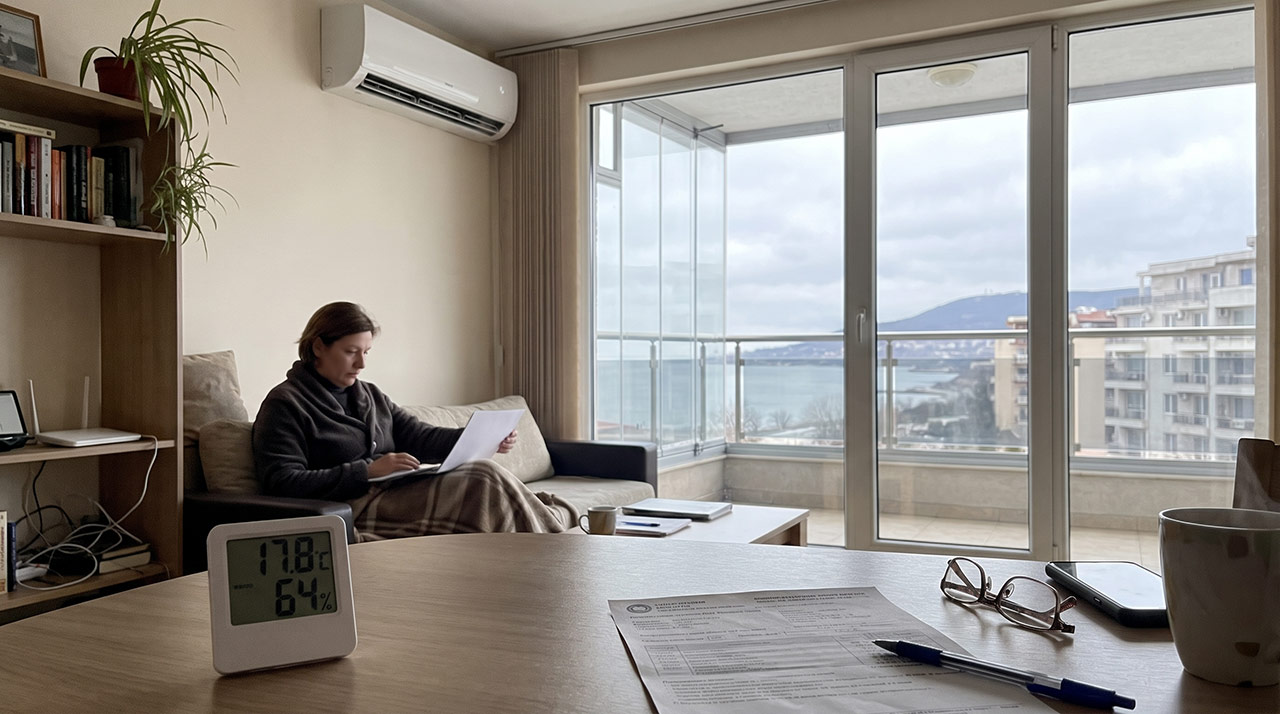
Winter by the sea in Bulgaria: real electricity rates, how much an air conditioner will run, and why bills of 250–300 euros are coming
In November, those who recently moved to the Bulgarian coast begin their biggest daily challenge—the first heating season without the usual central heating. Forums and chats often report that "winters in Varna and Burgas are mild, and inverter air conditioners are a pittance." But by December or January, many receive their first winter bill. Energo-Pro or EVN by 200–300 euros and don’t understand where these numbers come from.
We'll explore the real cost of a kilowatt-hour in Bulgaria, how much it costs to heat a one- or two-room apartment by the sea, and four simple tips to cut your winter bill almost in half.
1. How much does 1 kWh of electricity cost in Bulgaria (day and night rates)
In Bulgaria, there is a state-regulated tariff for residential consumers (KEVR Decision No. C-13, valid until June 30, 2027). The final price per kilowatt-hour depends on the regional supplier, but the difference between them is minimal.
An important nuance of the receipt: In EVN and Energo-Pro invoices, tariffs are first indicated without VAT (without VAT), and the 20% tax is added at the very bottom of the bill. Both figures are listed below to avoid confusion when checking your receipt:
| Supplier and region | Daily rate (total with VAT and network) | Daily rate (invoice excluding VAT) | Night rate (total with VAT and network) | Night rate (invoice excluding VAT) |
| ENERGY-PRO (Varna, Dobrich, North-East) | 0.15512 €/kWh | 0.12927 €/kWh | 0.09280 €/kWh | 0.07733 €/kWh |
| EVN (Burgas, Sunny Beach, Nessebar, Sozopol, South-East) | 0.15458 €/kWh | 0.12882 €/kWh | 0.09226 €/kWh | 0.07688 €/kWh |
| Electrohold (Sofia, Western Bulgaria) | 0.15425 €/kWh | 0.12854 €/kWh | 0.09192 €/kWh | 0.07660 €/kWh |
Night tariff validity hours:
- Winter period (from November 1 to March 31): с 22:00 to 06:00.
- Summer period (from April 1 to October 31): с 23:00 to 07:00.
Night kilowatt-hour costs 40% cheaper than daily (you save about 0,062 € (For each kilowatt). If you have an old single-tariff meter (single-tariff elektromer), all 24-hour consumption is calculated at the expensive daily rate.
2. How much energy is actually consumed in winter in Varna and Burgas: a comparison of heating methods
On the Bulgarian coast the main problem in winter is not the extreme cold, but high humidity (80–90%) and a piercing sea breeze, due to which concrete walls cool down quickly, and +5°C feels like -5°C.
Let's estimate the average consumption for an insulated apartment in the winter months (December–February), taking into account not only heating, but also the mandatory one in Bulgaria electric boiler, stove, washing machine and lighting:
- Studio or two-room apartment (1 bedroom + kitchen-living room, 45–55 m²):
- Household needs (boiler, cooking, appliances): 250–300 kWh per month (~35–42 €).
- Heating with a modern inverter air conditioner (class A++ / A+++): A single inverter, while maintaining a stable temperature, consumes an average of 0.5–0.8 kWh of electricity per hour (while generating 2–3 kW of heat). Over the course of a month, this amounts to 450–650 kWh (~€60–€90).
- Total real score for the month: 95–135 euros.
- Three-room apartment (2 bedrooms + living room, 75–90 m²) with two or three air conditioners:
- With 24-hour heating of all rooms, consumption easily reaches 1,100–1,500 kWh per month.
- Total real score for the month: 150–210 euros.
Why convectors and oil-filled radiators ruin your budget: A typical electric convector or "veterok" heater has an efficiency of 1:1—it outputs as much heat as it draws from the outlet. A good inverter air conditioner (air-to-air heat pump) produces 1:1 of heat per 1 kW of electricity. 3–4 kW of heat. Therefore, heating an apartment with convectors instead of air conditioners will cost 2.5–3 times more expensive (Those same bills of 250–350 euros for a typical two-room apartment). Pellet fireplaces or boilers are only cost-effective in private homes or large apartments over 100 m², where there's space to store pellet bags and a chimney.
3. The Hidden Trap of Resort Complexes: Industrial Tariff Without Act 16
If you have the same two air conditioners and you receive a bill for 300–400 euros, First of all, check the status of the house and the type of lot ("partida") for electricity:
- In buildings that not put into operation (no Act 16), or in apart-hotels where the meters are registered to the management company as a legal entity, the following applies non-domestic/industrial tariff at free exchange prices.
- Taking into account the exchange price of energy, network fees, excise tax and VAT, a kilowatt-hour there can cost 0.25–0.35 € and above — that is, in 2–2.5 times more expensive standard household tariff.
4. Four working life hacks for legally reducing your electricity bill in winter
- Keep the temperature at home at +17…+18°C instead of the usual +25…+27°C. This is the main secret of native Europeans, which actually saves tens of euros every month. According to the laws of thermodynamics, every additional degree of room heating above 18°C increases energy consumption by approximately 6–7%. The difference between a tropical +26°C in a T-shirt and a brisk +18°C in a warm lounge suit is Savings of about 45–50% on heating. Moreover, at low temperatures, the air in the apartment is not over-dried by the air conditioner, making it easier to breathe, sleep better, and boost immunity.
- Do not turn off the inverter air conditioner when you leave for 2-3 hours. The most common mistake beginners make is turning off the air conditioner before going shopping or for a walk, and then setting it to 28°C and maximum airflow in the evening. To warm up cool concrete walls and furniture, the compressor runs at peak power and burns 1.5–2 times more electricity than when the automatic mode is set to maintain a constant temperature. When leaving home, simply reduce the temperature by 2–3 degrees.
- Switch the boiler and washing to the night window (from 22:00 to 06:00). The boiler is the second-largest consumer after the heating system. Install a simple mechanical or Wi-Fi timer (costs €8–12) on the boiler outlet to heat water from 2:00 AM to 6:00 AM at the rate you set. 0.092 €/kWh instead of daytime 0.155 €/kWh. In the morning, you'll have a full tank of boiling water, and over the winter, you'll save 40-60 euros on just one boiler.
- Clean your air conditioner filters before the season. A dust-clogged indoor unit mesh reduces the air conditioner's heat output by 15–20%: the unit hums and counts, but produces little heat. Removing and rinsing the mesh in the shower takes 5 minutes and immediately returns the unit to its rated efficiency.





 Русский
 English
 Български
 Deutsch
 Română
 Українська
 Polski