
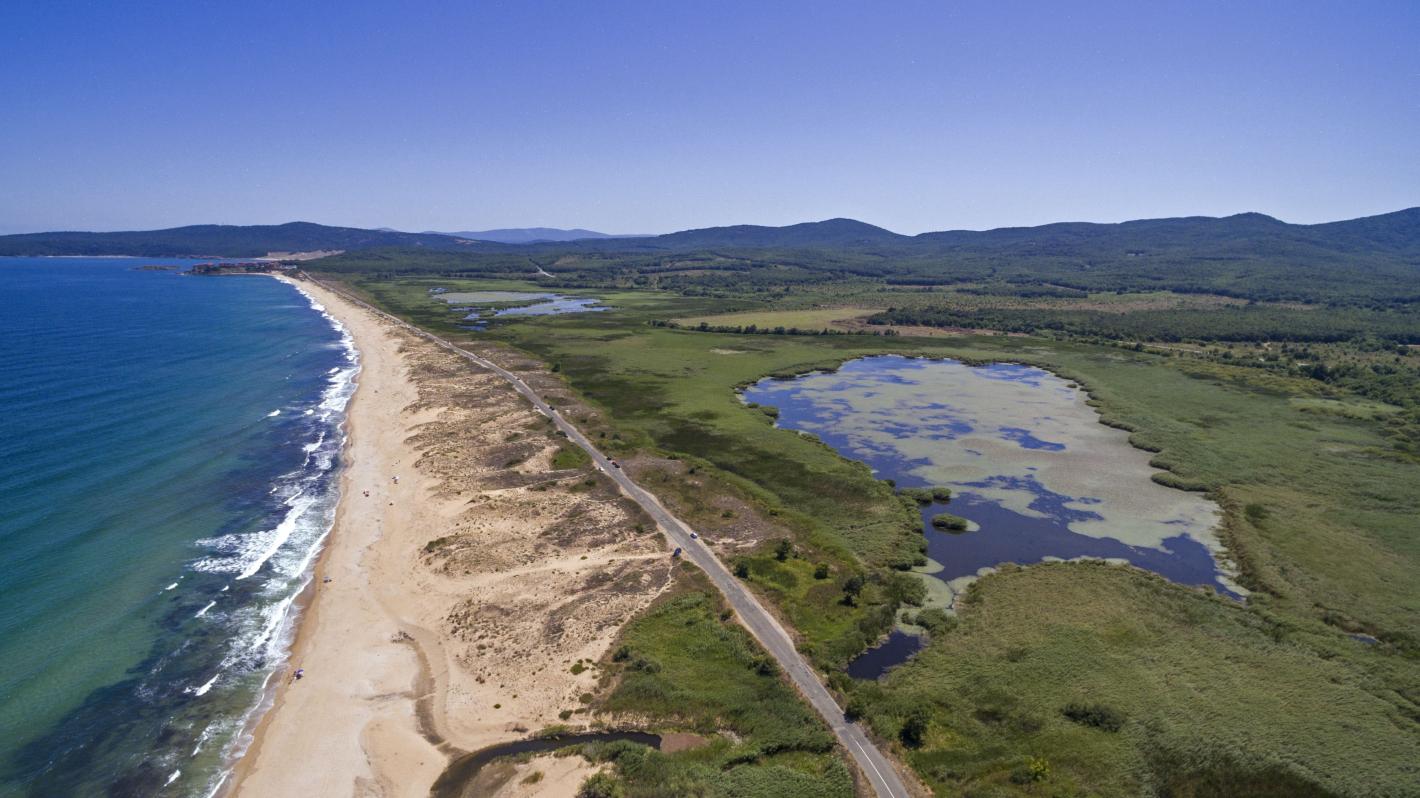
This area is overgrown with reeds, and the rest is covered with salt-loving algae. Shabla Tuzla is a natural landmark of exceptional ecological and sanitary significance. Shabla Tuzla is located approximately 6 km east of the city of Shabla. The lake is completely separated from the sea by an 80-meter-wide sandbar. This salt lake is a lagoon, formed primarily by the seepage of salty seawater under the sand dunes separating it from the sea.

The conservation value of the Shabla Tuzla is rooted in the fact that it is overgrown with reeds, while the rest is covered with salt-loving algae.
The origin and ecological characteristics of Tuzlata demonstrate that this small lake represents a unique coastal ecosystem with an exceptionally rich flora and fauna. The Red Book of Bulgaria lists 13 species of rare and endangered plants, as well as over 41 species of nesting birds.
The water balance of the salt lake Shabla includes both seawater and fresh groundwater from the Sarmatian limestones, which emerge at the surface. Thanks to this underground recharge, even in very dry years, the water cover above the mudflats, although reduced in area, remains intact, protecting it from acidification.
The conditions for the formation of mud in Shabla Tuzla are favorable, and therefore, over the course of thousands of years, aquatic flora and fauna have contributed to the formation of therapeutic mud with unique properties.
Compared to other salt deposits in Bulgaria's coastal lakes, Shabla Lake stands out for its exceptionally high quality and homogeneity. Its reserves, determined with a fairly high degree of accuracy based on the thickness of the silt layer, amount to approximately 200,000 tons.
It's truly a gift of nature. Its complex physical and chemical composition has beneficial effects on health. It boosts immunity, beautifies skin and hair, and helps treat several serious illnesses.
The healing properties of mud were discovered thousands of years ago and were used by a number of ancient civilizations – Egypt, the Roman Empire, Ancient Greece, India.
Subsequently, mud therapy's popularity grew in Renaissance Italy, France, Germany, and the Czech Republic. And today? Today, numerous resorts around the world rely on mud from nearby natural deposits.




 Русский
  English
  Български
  Deutsch
  Română
  Українська
  Polski